According to the study conducted by NielsenIQ (presented in March 2026 at CFIA Rennes), based on a retailer panel and a consumer panel (see methodological details in the box at the end of the text), it appears that among the many existing labels, Nutri-Score and Label Rouge are the most frequently cited by French consumers.
Analysis of the consumer panel data shows that 63% of respondents say they pay attention to the Nutri-Score when purchasing food.
Nutri-Score is on par with Label Rouge, which is mentioned by 64% of participants. It is worth noting, however, that Label Rouge has been in place for more than 60 years (whereas Nutri-Score has been gradually introduced on the French market since 2017).
The organic “AB” label ranks third, mentioned by 45% of participants, trailing Nutri-Score by 18 points (although it was introduced in 1985).
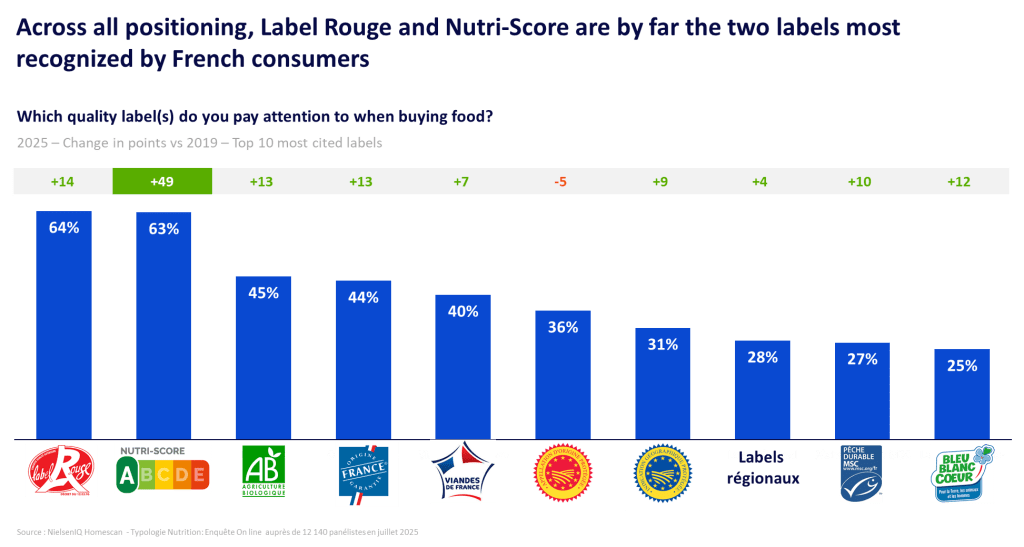
What is most striking about Nutri-Score is the evolution of its awareness in recent years. Its recognition has surged, increasing by 49 percentage points in 6 years (from 14% in 2019 to 63% in 2025). By comparison, over the same period, Label Rouge increased by only 14 points, the AB organic label by 13 points, and growth was much lower for all other labels.
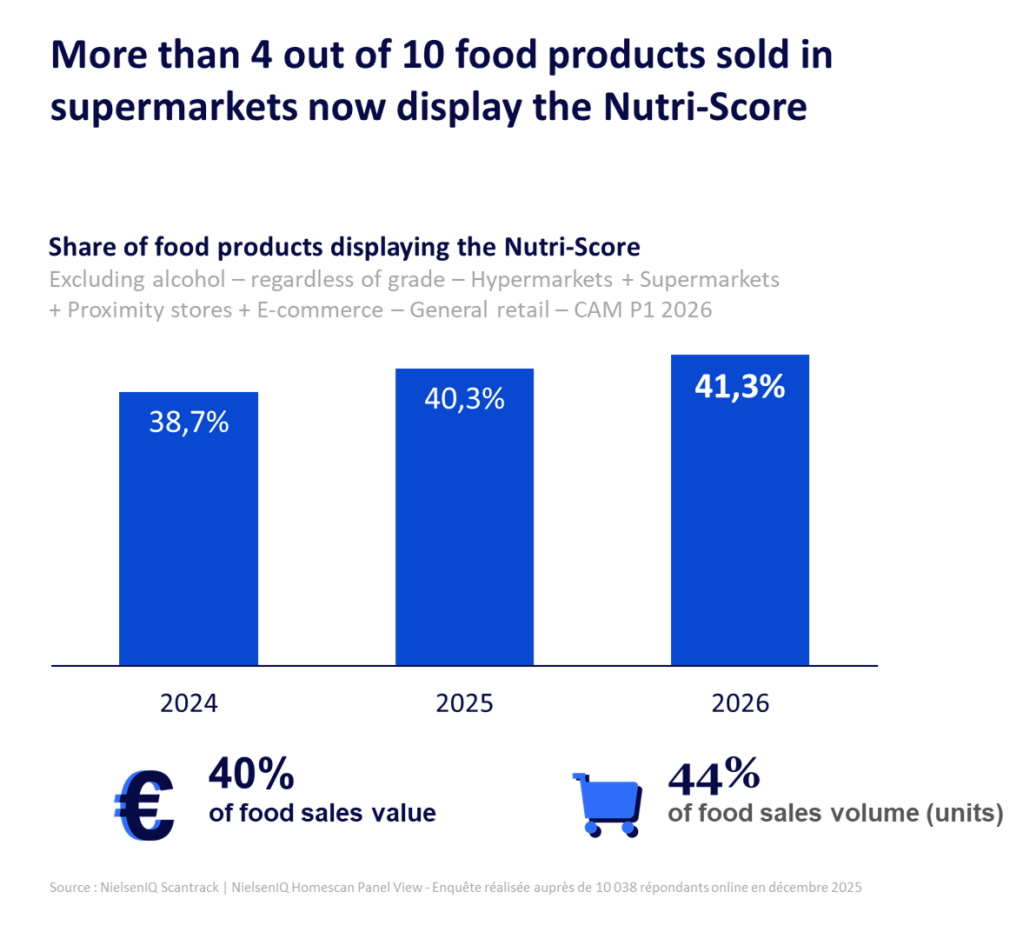
Analyses from the retailer panel show that currently, 41% of food products display the Nutri-Score on their packaging, a figure that has been increasing over the past three years.
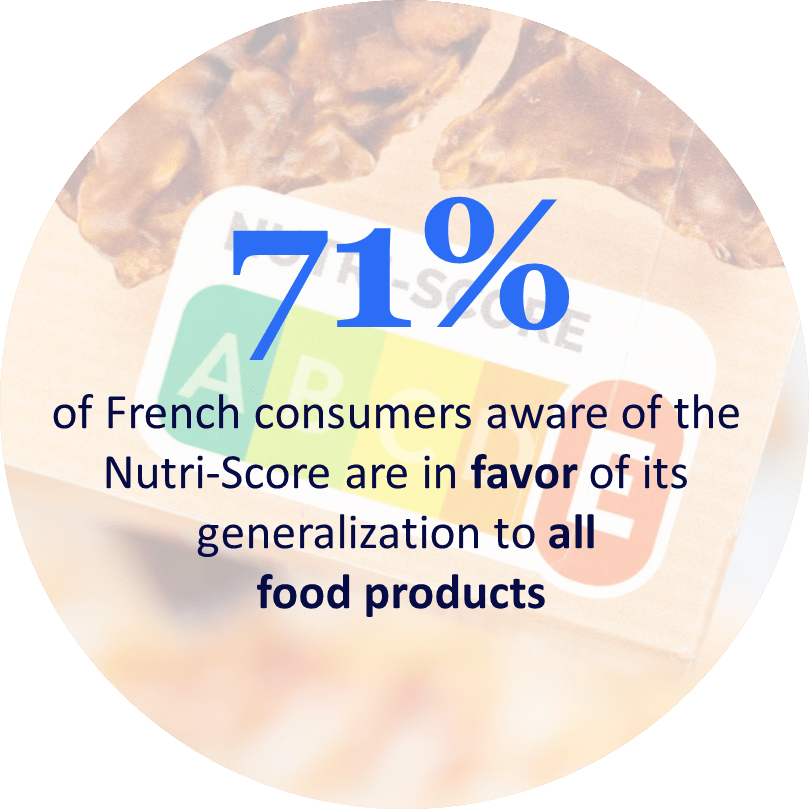
Although these figures are encouraging, they are still considered insufficient. A large proportion of French consumers would like the Nutri-Score to be displayed on all food products: 71% say they are in favor of its generalization across all food items.
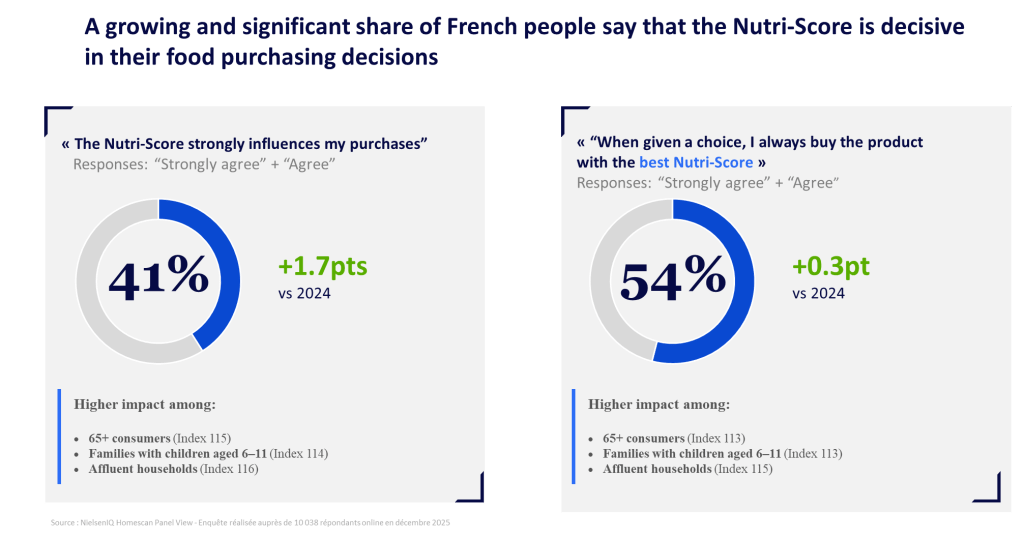
The results from the consumer panel also show that a growing share of consumers report that the Nutri-Score is decisive in their food purchases:
– 41% say the Nutri-Score strongly influences their purchases
– 54% say that when given a choice, they always buy the product with the best Nutri-Score
Methodology of the study
The specific results on Nutri-Score are based on:
1. A retailer panel. Checkout data are collected from 100% of hypermarkets and supermarkets, 99% of drive-through and home delivery services from major retail players, and 75% of convenience stores in mainland France.
These data make it possible to identify each product, its in-store performance, and all its characteristics (including the Nutri-Score), through the processing of barcode information and analysis of product visuals on all four sides.
This provides a comprehensive view of the performance of Nutri-Score-labeled products, including at a highly detailed level.
2. A consumer panel composed of 20,000 households representative of the French population across a wide range of socio-demographic criteria (age, household size, income level, place of residence, etc.) and shopping habits (e.g., representation of customers from each retail chain in France).
These households are asked to scan all their purchases of fast-moving consumer goods. This data source makes it possible, within the same scope as the retailer panel, to combine product information with purchasing behavior and socio-demographic data.
This panel also allows for survey-based studies (“Panel View”) on the Nutri-Score.
 NUTRI-SCORE