
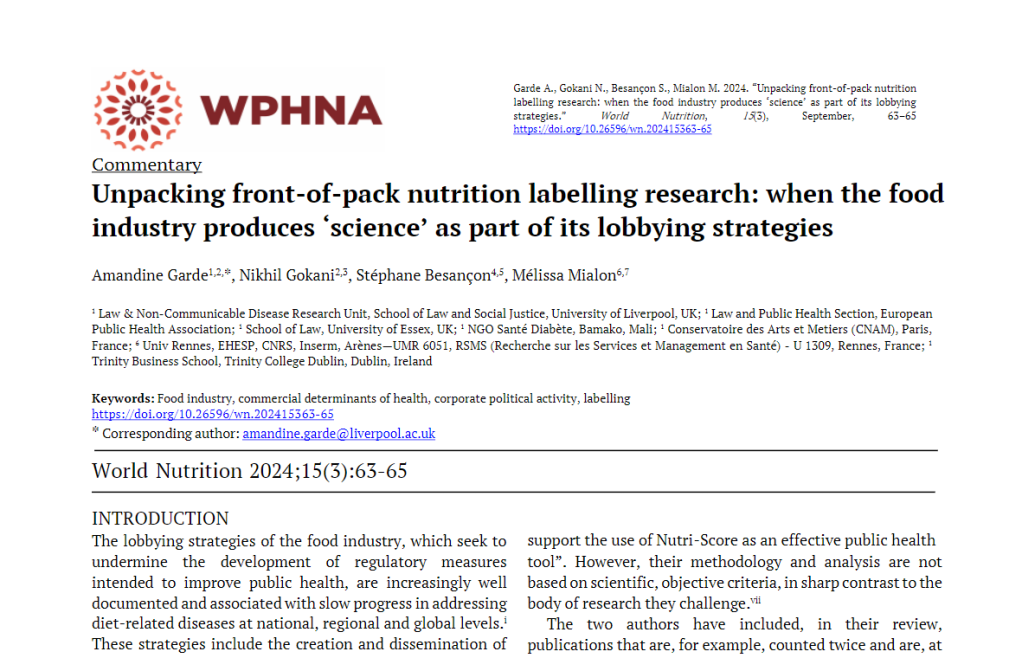
An article recently published in the scientific journal World Nutrition (WPHNA) « Unpacking front-of-pack nutrition labelling research: when the food industry produces “science” as part of its lobbying strategies » by four academic researchers – Amandine Garde (School of Law and Social Justice, University of Liverpool, UK), Nikhil Gokani (School of Law, University of Essex, UK), Stéphane Besançon (NGO Santé diabète, Bamako, Mali and CNAM Paris) and Mélissa Mialon (Université de Rennes, EHESP, CNRS, Inserm) – analyzed through the example of the Nutri-Score, several of the tactics large parts the food industry employ when seeking to derail ongoing regulatory processes intended to promote healthier diets.
These strategies include the creation and dissemination of biased research findings in order to skew evidence in the favour of the industry, and to cast doubt about the harms stemming from its products and practices.
Front-of-pack nutrition labelling (FoPNL), and especially Nutri-Score, provides fertile ground for industry opposition, which is discussed in this article.
The authors dissect a recent « article » published by two well-known lobbyists (funded by the dairy lobby), who try to discredit the vast body of scientific research that underpin Nutri-Score. They analysed three of the tactics that the food industry use to fight measures which aim at promoting healthier diets but which they consider as detrimental to their own interests:
– attack legitimate academic science through unscientific methodologies,
– fail to acknowledge the conflicts of interest stemming from existing ties with the food industry,
– denigrate the work of academic scientists working to promote public health.
Authors concluded that more recent research has found that the Nutri-Score has the highest potential of all four labelling schemes under review by the European Commission for yielding positive health and economic outcomes. Notwithstanding its obvious shortcomings, the lobbists paper will fuel claims by industry and those involved with them that “we need more evidence”.
Such a publication should not serve to jeopardise legitimate policy processes and further delay the long overdue proposal of the European Commission for an EU-wide, harmonised FoPNL scheme. Populist, industry-led tropes, should not be masquerading as scientific research intended to inform public health policy. They are misleading and must be condemned as such
Read the full article on:
https://worldnutritionjournal.org/index.php/wn/article/view/1050
 NUTRI-SCORE