
Danone made the consequential decision to abandon the display of the Nutri-Score on five of its brands (Actimel, Activia, Danino, Danone, Hi Pro) corresponding mainly to its range of yoghurt drinks and vegetable drinks. The reason given for this decision is the introduction of the revised Nutri-Score, in accordance with its premises. In fact, its algorithm was recently updated by the European Scientific Committee that is in charge of this task; it is now perceived by Danone as penalizing for these two types of food it markets. Nonetheless, it should be highlighted that Danone has decided to retain the display of the Nutri-Score for its other brands (Taillefine, Jockey, Gervais, Gervita, Fjord,…) for which the new Nutri-Score does not affect the classification of its products, simply because these products are not at all or not very sugary.
A very regrettable and disappointing decision
This decision is regrettable and very disappointing especially since it comes from a company which, for the past few years, has been cultivating an image of an agri-food group with a strong social commitment and which has until now claimed to place “health for all through food” at the heart of its social position. In 2019, Danone became the first publicly-traded company to adopt the “Société à Mission” status created by the French “Pacte” law in 2019. A “Société à Mission” is defined as a company whose objectives in the social, societal, and environmental fields are aligned with this purpose and set out in its by-law. Notably, one of its four goals as a “Société à mision” is to “improve health everywhere, every day, through a portfolio of healthier products, brands that encourage better nutritional choices, and the promotion of better dietary practices” including “helping consumers make informed food choices.” The suppression of the Nutri-Score is therefore completely contradictory to one of the four objectives stated by Danone.
Until recently, Danone boasted as a pioneer among the agri-food companies that adopted Nutri-Score in 2017 for the purpose of nutritional transparency and to help consumers make healthier food choices. The decision to remove the Nutri-Score from their products shows that Danone, contrary to the virtuous image it is trying to project, in fact takes at heart its commercial and marketing interests and not the interests of consumer health. Danone shows a conditional conception of transparency: they display the Nutri-Score on product brands when it suits them (i.e. when these products are well ranked) but not when the company considers that such transparency may be detrimental to its business interests.
Updating the Nutri-Score: an indispensable science-driven process
The Nutri-Score algorithm update, contested by Danone, was carried out by a European scientific committee composed of experts in nutrition and public health from the 7 countries that have adopted Nutri-Score (France, Germany, Belgium, Spain, the Netherlands, Luxembourg and Switzerland). This European Scientific Committee was established by the transnational governance of the Nutri-Score in 2021. The Scientific Committee members have no conflicts of interest. Independent of the economic and political authorities, they worked for two years to produce two well-documented reports, in 2022 and 2023, on the updated algorithm underlying Nutri-Score (135 pages and 49 references for general foods and 104 pages and 164 references for beverages respectively).
Similar to dietary guidelines, the Nutri-Score was expected to evolve and the need for an algorithm update was expected from its inception in 2014 and brought up again in 2017 when the French government formally adopted the Nutri-Score. The justification was that any nutrition label should be regularly revised in light of (1) advances in science (growing knowledge of the relationship between diet and health) and the need to be consistent with the latest public health nutritional recommendations, (2) market developments (new products are appearing, others are being reformulated), and (3) some setbacks experienced during its initial implementation (e.g., 7 years of setbacks in France) which brought awareness of product classification problems for a small number of foods.
Upon adoption of the Nutri-Score, all companies were aware of the planned periodic review of its underlying algorithm. The work of the Committee’s scientists has been a true exercise of collective scientific expertise conducted neither to go against the food industry nor to please them, but dictated only by the desire to improve the Nutri-Score label in terms of public health, in the interest of consumers. Minor changes to the algorithm have corrected identified imperfections.
It is quite unacceptable for Danone to allow itself to criticise the decisions of independent scientific experts, especially those perceived as disturbing their interests. These decisions are based on sound science with references to work supporting the proposed amendments. Among the various modifications (scientifically justified), one pertains to the increase in negative points (i.e., unfavourable classification) attributed to products (solid or liquid) containing sweeteners and those with high amounts of sugar or sodium. Other changes pertain to the reduced ranking (i.e., more unfavourable)of red meat and the improved (i.e., more favourable) ranking of whole-grain products (compared to their refined counterparts), olive oil, and fatty fish.
Scientific justification for the Nutri-Score update specifically as it relates to drinking yoghurt and vegetable drinks
Danone seemed particularly unhappy with the Scientific Committee’s conclusion that a modification of the Nutri-Score algorithm was needed for various categories of beverages: dairy drinks with a high sugar content (but also drinks with a low sugar content and drinks containing sweeteners). After an intense period of 18 months of work, the Committee proposed some changes to the Nutri-Score calculation, some of which Danone finds displeasing: unlike before, milk drinks, milk-based fermented drinks and vegetable drinks are now logically included in the drinks category and not in the general foods category (which had allowed them to display a more favourable Nutri-Score that was misaligned with public health recommendations).
This is important because the sugar content of these drinks – drinking yoghurts, sweet milk drinks (flavoured milk) and herbal drinks (including soy, almond, oat, rice drinks, etc.) – varies considerably between sugar-free and high sugar versions of the products. Some of these products may contain 10 to 13 g sugar/100 ml (i.e. the same as amount found is sodas) but had been erroneously given a Nutri-Score A or B based on the general food calculation method. It should be noted that in the beverage category, the sweetest soft drinks (which contain the same amounts of sugar as drinking yoghurt or other sweet vegetable drinks) are classified as Nutri-Score E.
Overall, the updated Nutri-Score calculation method for beverages allows for a better alignment between the Nutri-Score ranking and current public health nutrition recommendations aimed at limiting the consumption of sugary drinks. In addition, the revision improves the ability of the Nutri-Score to discriminate between the nutritional qualities of different types of milk, drinking yoghurts, flavoured milk drinks and vegetable drinks, in particular by easily highlighting those with a high sugar content.
Scientific responses to Danone’s arguments criticising the Nutri-Score revision
Contrary to statements made by Danone, it is not all yoghurt and vegetable drinks that are generally penalised! It is actually just the sugary versions of these products that have their Nutri-Score ranking reduced (see Addendum). With the Nutri-Score update, versions of these products either without or with low amount of sugars (less than 4%) still rank well in green/B (knowing that among beverages, only natural spring water without anything added to it can be classified as A). Only sugary forms of drinking yoghurt and vegetable drinks are classified as C, D or E according to their sugar content, which can in fact vary from 5 g to almost 13 g of sugar per 100 mL.
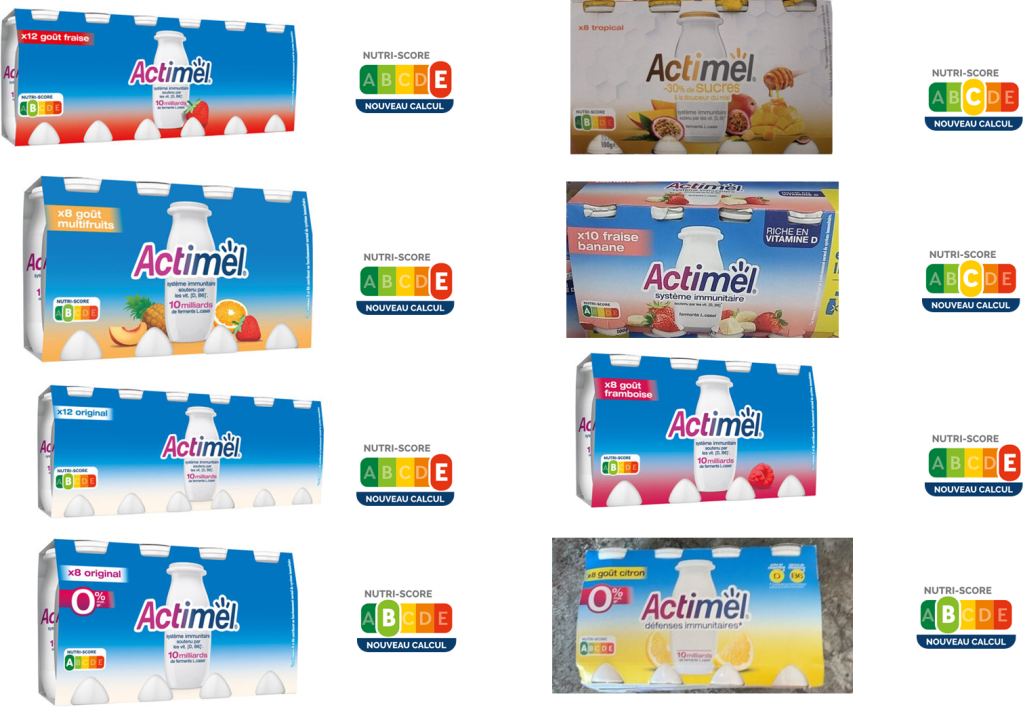
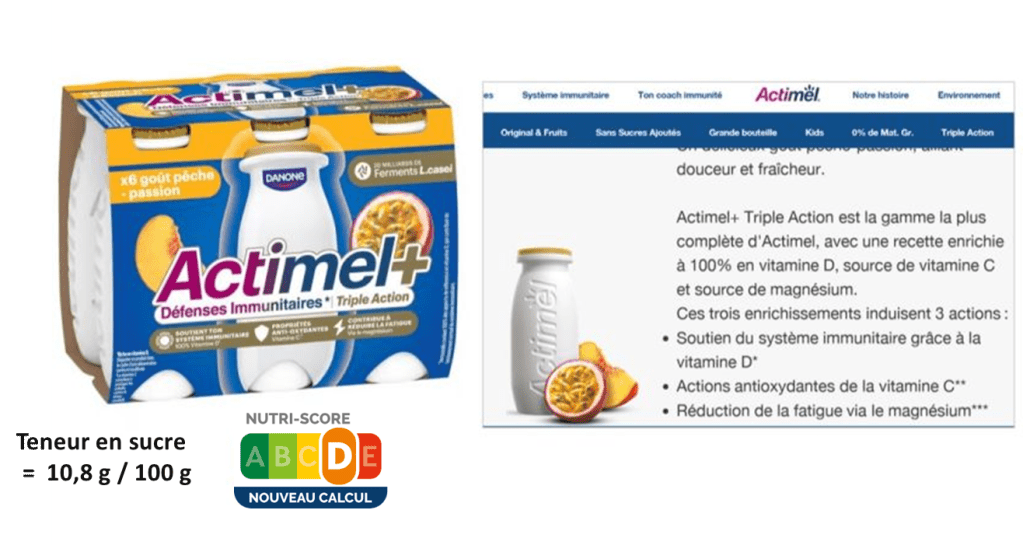
This new classification for these products is therefore fully justified and useful to consumers, allowing them to consider differences in nutritional quality related to the differences in sugar content; for example. the different Actimel or Activia products are now classified from B to E whereas previously they were mostly ranked as A or B (yet, some forms of Actimel contain 10.8 g sugar per 100 ml).
Curiously, Danone criticises the fact that these products were classifies by the Scientific Committee as beverages, even though the manufacturer call them ‘drinking yoghurt’ or ‘beverages based on almonds, oats, rice, etc.’. It is therefore difficult to refute that these products are beverages and thus subject to the Nutri-Score calculation method applied to the beverage category.
Danone tries to justify its criticism of the scientific work of the European Nutri-Score Committee in charge of the update of Nutri-Score by trying to make it appear that the change in its calculation method (the one used for beverages) results in an inconsistency for the Danonino brand. They point out that flavoured and sugary Danonino yoghurt (a classic solid product that is eaten with a spoon) and the drinking form of Danonino (which by definition is drunk) contain the same amount of sugar yet do not have the same Nutri-Score classification. The solid form remains ranked as B while the ranking of the drinking form moved from B to D. It should also be noted that for Danone fruit yoghurts (which contain only 6% fruit) the sugar content is the same across the solid and drinking versions, in the order of 10 to 13 g of sugar per 100 g or 100 ml. following the update, the ranking of the solid form changed from B to C (because of the higher penalty for sugar for general foodstuffs) while the liquid form changed from B to D (because of the higher penalty for sugar and the switch from the general food to the drinks category).
In fact, this differentiation between solid and liquid forms (even with an equivalent nutritional composition) is justified by multiple arguments (along with their bibliographic references) presented in detail in the report of the Scientific Committee in charge of updating the Nutri-Score. For example, the viscosity, and thus the gastric emptying and gastrointestinal passage time, of milk and milk drinks is quite similar to that of other drinks, such as fruit juices, placing them in the category of beverages from a physiological viewpoint. It has also been shown that gastric emptying times are shorter for liquid foods than for their isocaloric solid-form equivalents, probably due to satiety mechanisms involving hormones, such as ghrelin and insulin.
Another important argument is that, given their liquid nature and the distribution of the nutritional elements they contain, the classification of milk, fermented milk drinks, milk drinks, and herbal drinks, using the previous calculation method for ‘general foods’ did not allow for adequate differentiation of these products, in particular as regards their differences in sugar content.
The report also highlights that solid and liquid forms of yoghurt do not have the same benefits in terms of potential health effects. Although some studies suggest a favourable effect of the consumption of non-fat dairy products and fermented milk (yoghurt) in terms of reducing the risks of cardio-metabolic conditions (with heterogeneous results), this effect is not found for sugary dairy products and in particular milk-based products fermented in a liquid form. Evidence suggests that they are not associated with the same beneficial effects as solid fermented products. Various studies also suggest that free sugars added to drinking yoghurt can be notably more unfavourable to health than those added to solid yoghurts.
Finally, the actual use of solid and liquid forms of these products by consumers is different. Drinking yoghurts are used as a beverage. Unlike solid yoghurts, which are usually consumed as part of a meal, drinking yoghurts are consumed very frequently outside meals (they can be considered as liquid snacks). They were created to be convenient to consume (no spoon needed) and easy to take everywhere, with pleasant sweet flavoured forms; they have been attractive especially to children and teenagers. All of these aspects favour their consumption outside of meals. Moreover, for some of these products, the promotion of their nutritional quality falsely suggests that they have a health benefit. This is certainly not the case for the sweetest forms whose consumption, on the contrary, must be limited. Some products include nutrition claims on their packaging likely implying potential health benefits, as regards the consumers’ reasoning: i.e., “vitamin D-rich”, “calcium-rich good, for children’s growth”, “covers 1/3 of vitamin D requirements”, “contains probiotics”, “protein-rich”, “immune system support”, etc. These claims may make consumers feel comfortable about eating them in larger quantities, despite the large amounts of sugar which they contain and which were not properly accounted for by the original version of the Nutri-Score.
With the Nutri-Score update that correctly classifies the sugary forms of these products as D or E, consumers therefore have access to information that reminds them that these products can still be part of a balanced diet, but on the condition that they are not consumed in large quantities or frequently, which was implied by their previous favourable Nutri-Score (A or B) classification. Thus, with the new classification, criticised by Danone, consumers can compare products with each other and, having full knowledge of the facts, turn towards the least sugary forms or limit the consumption of the most sugary forms if they wish to consume them.
Finally, among the arguments put forward by Danone to criticise the Scientific Committee’s choices to classify drinking yoghurts and vegetable drinks in the category of beverages (with the most unfavourable consequences of the updated calculation method for the sugary versions) is the fact that soup (which is also liquid) remains in general foods and not in the beverages category, as regards the Nutri-Score calculation. But, consumption patterns of soups are not the same as those of liquid yoghurt and vegetable drinks. Vegetable soup is eaten during meals and not considered as a « snacking » product. Unlike liquid yoghurts or vegetable drinks that are drunk, soup is not drunk, it is eaten…
The report also points out that other interpretative nutritional labels – the Swedish Green Key and the Finnish Heart Symbol – similarly distinguish between liquid and solid versions of drinking yoghurts. The scientific justification for the modification of the Nutri-Score algorithm proposed by the Scientific Committee is fully consistent with the scientific points used by other nutritional labels to differentiate, in the same way, liquid products from their solid equivalents.
Conclusion
Finally, none of Danone’s justifications for removing the Nutri-score from their products is acceptable from a public health viewpoint. Their unscientific arguments are trying to mask the real reason for Danone’s decision: their fear of a negative impact on the sale of its products (see Addendum). Thus, Danone, trying to cast doubt on the work of scientists, joins the camp of industrial lobbyists who have already complained about the revision of the Nutri-Score (e.g., manufacturers of drinks containing sweeteners, of red meat, of sweet/salty/fatty products, Bjorg, etc.) and of the major traditional opponents of the Nutri-Score (e.g., Ferrero, Lactalis, Coca-Cola, Mars, Mondelez, Kraft, etc.). A company like Danone, which campaigned until recently to make Nutri-Score mandatory in Europe (see, for example, its press release of April 28, 2020), was expected to do better, even if the update of Nutri-Score (rightly) affected some of its flagship products. For the benefit of consumers it would have been useful for Danone to play the game of nutritional transparency to the end, and work to improve the nutritional quality of its drinking yoghurts and vegetable drinks by reducing their sugar content, which will also improve their Nutri-Score ranking…
The disappointment of Danone’s decision is up to the expectations that one could have of an agri-food company that until now displayed a willingness to put the interest of consumers at the heart of its concerns…
ADDENDUM:
THE IMPORTANCE OF THE LUCRATIVE BUSINESS OF DRINKING YOGOURTS AND ESPECIALLY ACTIMEL FOR DANONE: THE ECONOMIC CONTEXT OF THE WITHDRAWAL OF DANONE FROM THE DISPLAY OF THE NUTRI-SCORE
Actimel is the leading brand contributing to the growth of Danone in France and is the first of the ultra-fresh brands of Danone’s portfolio in Europe. Actimel is consumed by 4 million households in France and 32 million worldwide. In France, the Actimel brand has an annual turnover of 800 million euros and it is a growing market (+13% over one year). Unit sales increase 2%, when food consumption slows overall. And while at the price per kilogram of yoghurt, the natural Danone yoghurt products consumed with a spoon cost around 2 euros, Actimel costs around 4 euros, or twice as expensive!
However, this was not visible until now. Also the vast majority of Actimel products, while emphasizing some health benefits, are highly sweetened (10 to 13 g of sugar per 100 mL). The revision of the Nutri-Score legitimately shifts them from an A/B to a D/E ranking according to their sugar content, which is mostly linked to the presence of added sugars; only the natural form without any added sugar – which is not the most consumed version – remains classified as B.
It should be borne in mind that the D or E classification of the Nutri-Score does not mean that the food should not be consumed. It simply means either that it may be more beneficial to favour a better rated version, if possible, or that the D/E rated products should not be consumed in very large quantities and/or not very frequently, in the interest of health.
And it is interesting to note that 8 days after having announced its withdrawal from the Nutri-Score initiative for its drinking yogourts (including the Actimel brand) and its vegetable drinks, Danone announced the launch of a new version of the Actimel, the Actimel+ Triple Action, with different fruit flavours (strawberry-pomegranate, peach-passionfruit, etc..) and new “health arguments”. According to Danone (and as displayed on the packaging), the products use a recipe enriched with 100% vitamin D, a source of vitamin C, and a source of magnesium. Danone argues that all three of these fortifications would lead to three health benefits: support of the immune system via vitamin D, antioxidant action of vitamin C, and a reduction of fatigue via magnesium…
So Danone chooses to put forward arguments that might indirectly and positively impact health, but on the other hand, wants to hide the reality of the unfavourable nutritional quality of a large number of its products (linked to their high added sugar content). And it is not the vitamins D and C and magnesium that have been added that justifies not informing consumers about the high sugar levels.
Danone certainly doesn’t find it easy to tout the health virtues of a product that is rated D or E by the Nutri-Score. It would have been more desirable for Danone to work on reformulating its products by reducing added sugars, to offer products more in line with public health recommendations to limit the consumption of sweet products.
This suppression of Nutri-Score reflects Danone’s victory in marketing over public health. It is particularly regrettable and disappointing from a company that wants to show a health-focused image promoting health through food…
Danone’s decision to remove Nutri-Score from some of its brands has been denounced by numerous consumer associations and associations involved in the health sector in France: FoodWatch, UFC/Que Choisir, CLCV, 60 Million Consumers, France Assoc Santé…
In this follow-up, FoodWatch has launched a petition: “the agri-food industry must not go backwards!”
https://www.foodwatch.org/fr/sinformer/nos-campagnes/transparence-et-scandales/logo-nutri-score/petition-nutri-score-l-agroalimentaire-ne-doit-pas-faire-marche-arriere
 NUTRI-SCORE