
A study conducted by a multidisciplinary team of researchers from the University of Aix-Marseille (France) and Sorbonne Paris Nord University (France) has demonstrated that displaying the Nutri-Score on food products in advertisements can help consumers to make healthier food choices.
The study was published on April 17th in the International Journal of Behavioral Nutrition and Physical Activity.
Advertising for foods high in sugar, fat, or salt encourages consumers to buy and consume them, thereby increasing the risk of obesity and chronic disease. Fighting the harmful effects of advertising for foods with a low nutritional quality is a recognized public health objective. In this line, researchers at Aix-Marseille University and Sorbonne Paris Nord University assessed the impact of displaying the Nutri-Score in advertisements on consumers’ food choices.
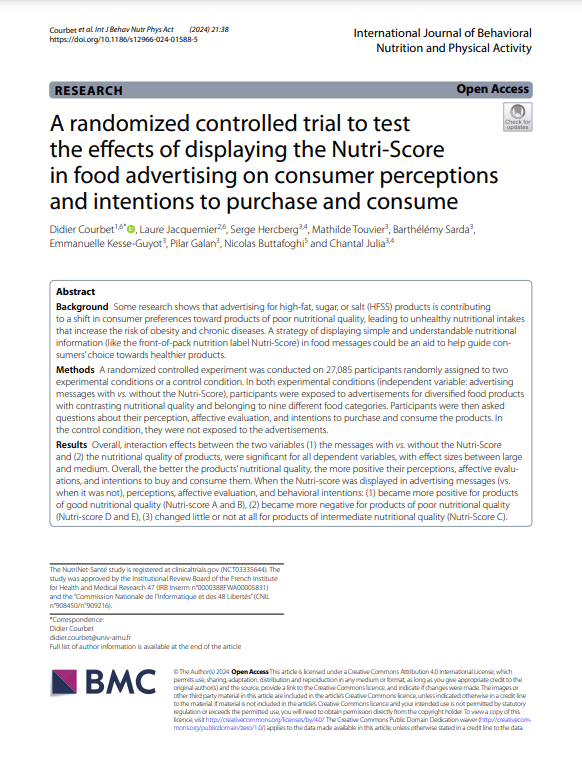
This study is based on a randomized controlled trial involving 27,085 participants from the NutriNet-Santé cohort, randomly divided into three groups. Participants in the first group were exposed to advertisements for foods with contrasting nutritional qualities and belonging to nine different food categories (cereals, drinks, breakfast, bars, biscuits, savory snacks, cooked meats, ready meals, and desserts) in which the Nutri-Score was displayed. The second group was exposed to the same adverts but without the Nutri-Score being displayed. In the third group, participants were not exposed to any advertising (control group). All participants were asked to complete an online questionnaire about their perceptions of all the products and their intentions to buy and consume them.
The results revealed that displaying the Nutri-Score in advertisements led to:
(1) better perceptions of foods classified as Nutri-Score A or B (of the most favorable nutritional quality) with stronger intentions to buy and consume them,
(2) less favorable perceptions, with lower intentions to buy and consume products labeled Nutri-Score D or E (of poorer nutritional quality),
(3) little or no effect on perceptions and intentions to buy and consume foods of intermediate nutritional quality (Nutri-Score C).
This research shows that displaying the Nutri-Score in advertising messages can genuinely help consumers steer their choices towards foods of better nutritional quality, which would be better for their health. Regulations making it compulsory to display the Nutri-Score in food advertisements could therefore be an effective public health measure in the fight against the obesity epidemic and nutrition-related chronic diseases among adults and children. This measure could effectively complement another regulation supported by numerous public health organizations: a ban on advertising Nutri-Score D and E food products targeting children during the day.
Référence of the original paper :
Courbet, D., Jacquemier, L., Hercberg, S., Touvier, M., Sarda, G., Kesse-Guyot, E., Galan, P., Buttafoghi, N., & Julia C.
A randomized controlled trial to test the effects of displaying the Nutri-Score in food advertising on consumer perceptions and intentions to purchase and consume.
Int J Behav Nutr Phys Act 21, 38 (2024).
https://doi.org/10.1186/s12966-024-01588-5
 NUTRI-SCORE